1982
Böblingen
DIE INSTANZ is formed. The first concerts take place in small clubs, industrial spaces and alternative venues in West Germany. The lyrics revolve around authority, discipline, work, propaganda, fear and obedience.

ALLES IST NORMAL
Everything is normal. Please continue.
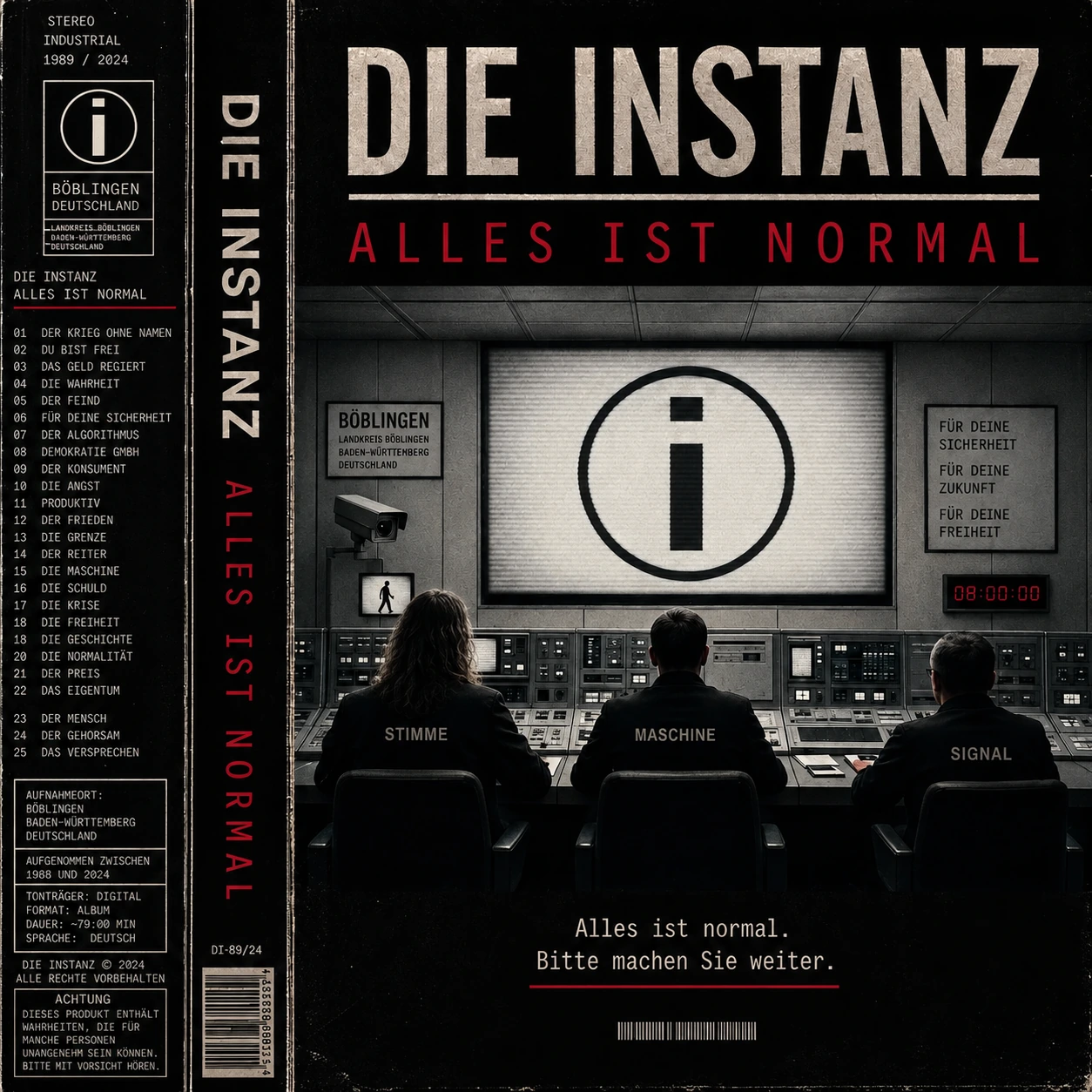
DIE INSTANZ was formed in Böblingen, Baden-Württemberg, in 1982 by STIMME, MASCHINE and SIGNAL. They came from different backgrounds but shared a fascination with the new German electronic music, sequencers, drum machines and the possibility of building music by removing almost everything they considered unnecessary. From the beginning they did not want to make futuristic music: they wanted functional music - rhythm, repetition, voice and message.
DIE INSTANZ is not about a conspiracy. It takes recognizable mechanisms of modern society - power, money, propaganda, technology, fear, war, consumption, bureaucracy and surveillance - and pushes them to an extreme. The result seems exaggerated until something begins to feel familiar.
DIE INSTANZ is formed. The first concerts take place in small clubs, industrial spaces and alternative venues in West Germany. The lyrics revolve around authority, discipline, work, propaganda, fear and obedience.
The fall of the Berlin Wall disrupts the internal balance of the group. SIGNAL wants to continue, MASCHINE believes they have lost the adversary that fed part of their language, while STIMME thinks the opposite: perhaps they had always been looking for the adversary in the wrong place.
After failed recording sessions, they put the machines away. They never officially announce a breakup. They simply stop playing. For more than two decades they follow separate paths, without reunions or nostalgia.
Through different personal circumstances, all three eventually retreat to Mallorca and discover that they are once again living only a few kilometres apart. A chance meeting ends in dinner. They talk about the Internet, surveillance, algorithms, money, wars, propaganda, consumption, technology, fear and conformity.
They decide to make music again on one condition: they will not reconstruct the past. There is only one computer on the table. MASCHINE programs. SIGNAL builds, records and destroys sound. STIMME writes and provides the voice.
Authority no longer always gives orders. Surveillance no longer needs to hide. Propaganda no longer comes only from the state. Obedience can present itself as a choice. DIE INSTANZ returns not as an exercise in nostalgia, but as a continuation.
STIMME writes and speaks. MASCHINE programs. SIGNAL captures and transforms. Individual identity remains secondary; the message occupies the centre.
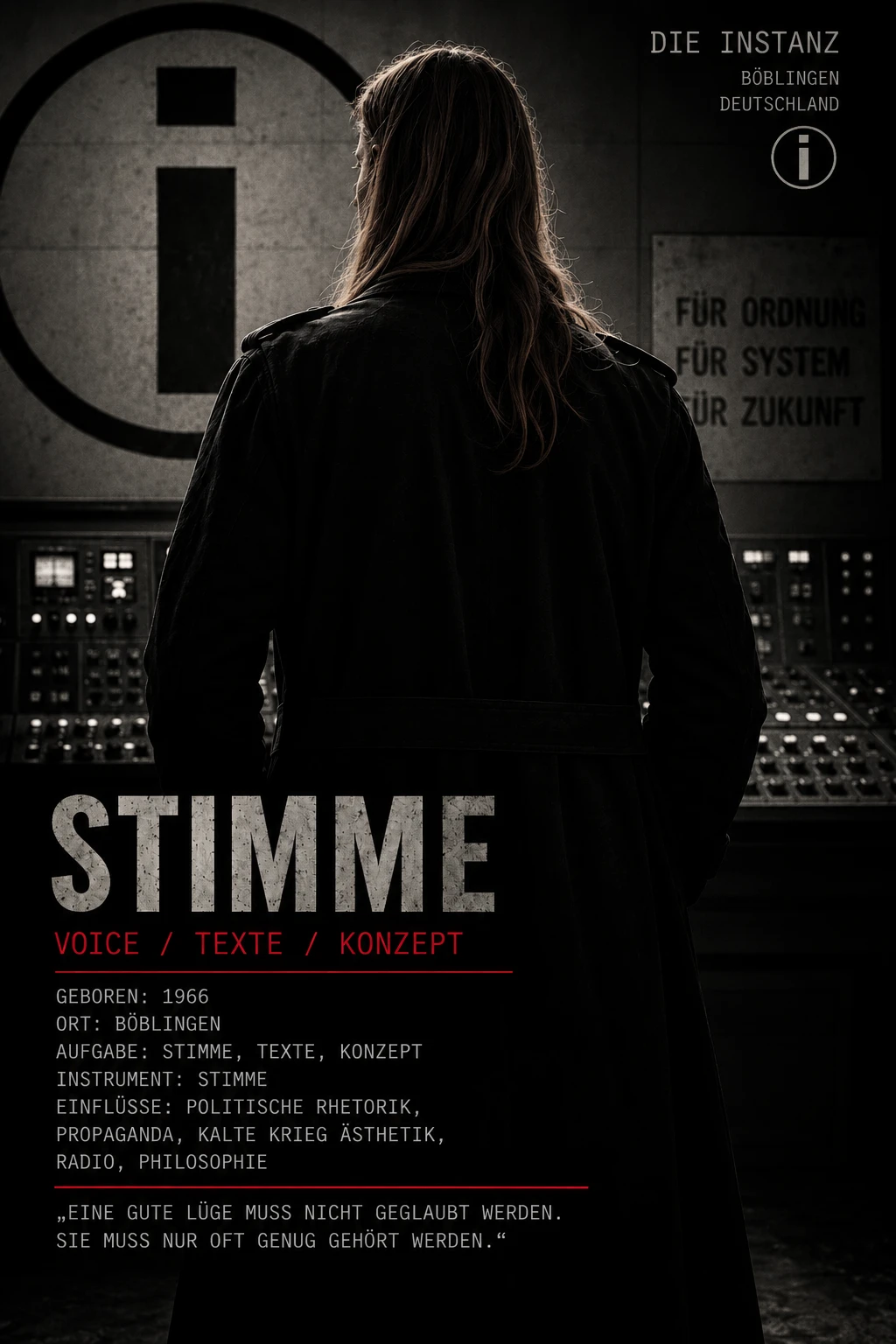
Born in Böblingen in 1966, STIMME grew up in an environment shaped by the industry of Baden-Württemberg. From an early age he became interested in political philosophy, propaganda, Cold War radio and the way institutional language can alter the perception of reality. He does not consider himself a conventional singer: for him, the voice is an instrument of authority. His deep, dry, almost bureaucratic delivery is built from short phrases, repetition, commands and slogans. He is the principal author of DIE INSTANZ’s lyrics and concepts.
«A good lie does not need to be believed. It only needs to be heard often enough.»
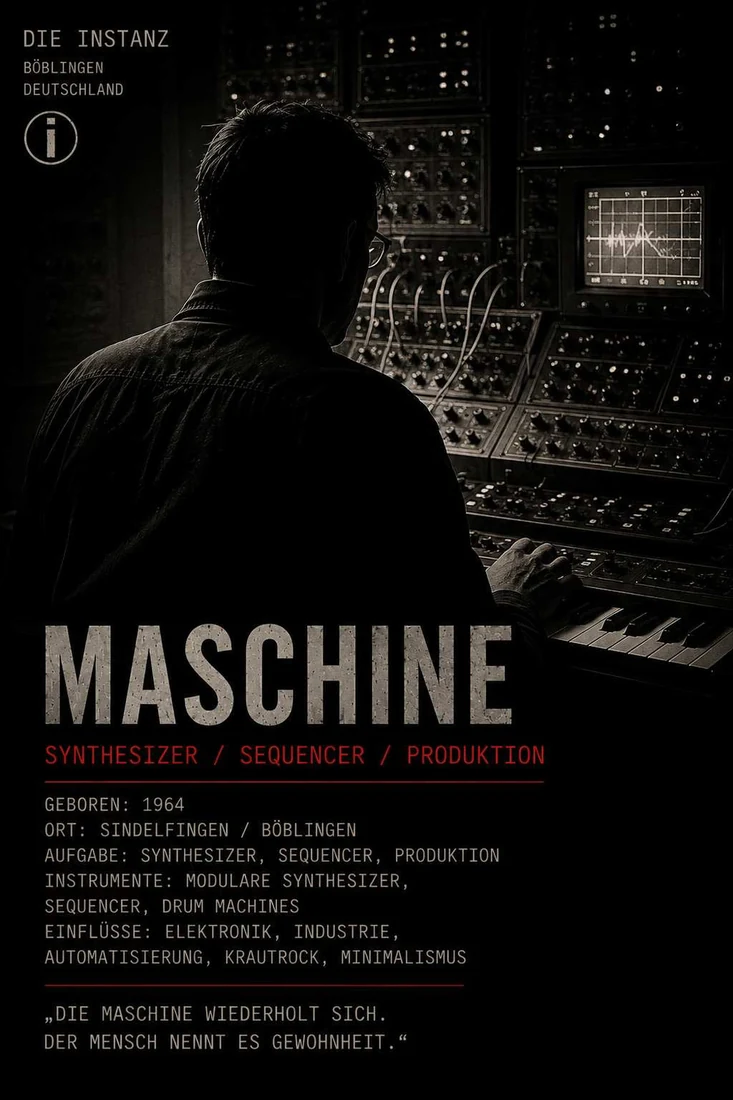
Born in Sindelfingen in 1964 and later based in Böblingen, MASCHINE is the group’s most technical member. His fascination began with electronics, industrial automation and computers before music itself. He modifies equipment, builds sequencing systems and turns mechanical rhythm into musical language. He believes a machine does not need emotion in order to provoke it. This is why repetition in DIE INSTANZ is not merely a musical device: it is structure, tension and message.
«The machine repeats itself. The human calls it habit.»
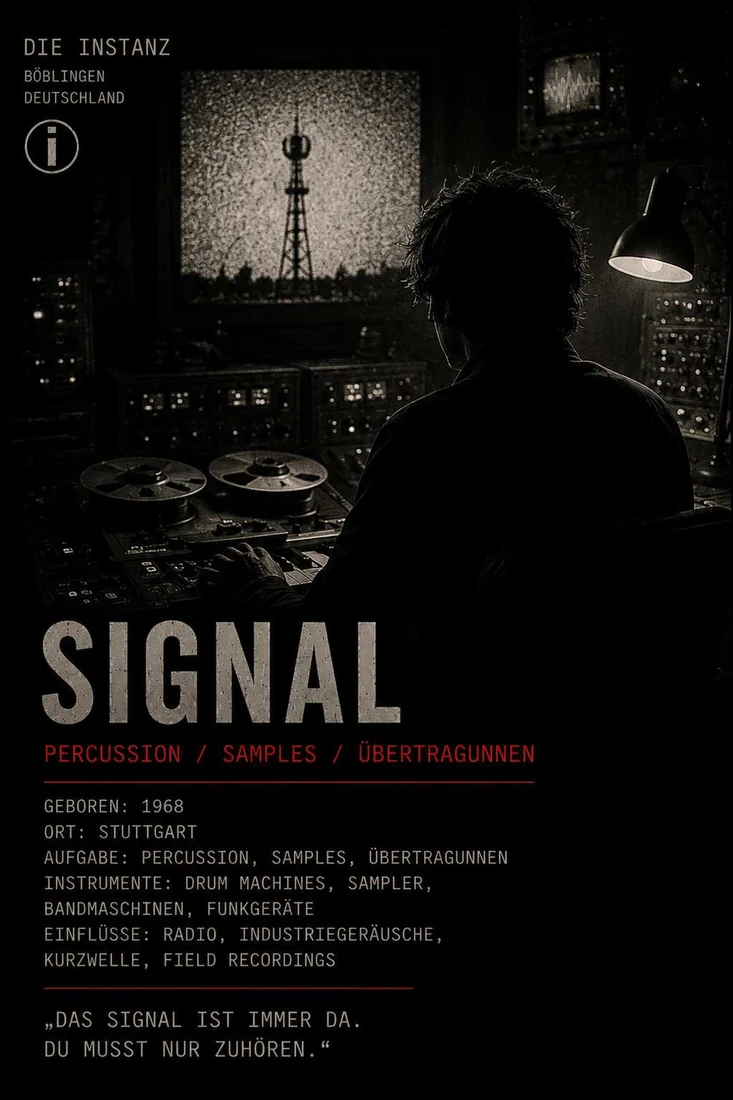
Born in Stuttgart in 1968, SIGNAL is the group’s most elusive member. Fascinated by radio and transmission systems, he records late-night broadcasts, interference, shortwave, news bulletins, speeches, alarms and industrial noise. Many DIE INSTANZ sounds do not come from synthesizers but from metal doors, motors, relays, printers, factories and magnetic tape. SIGNAL believes the world is already producing music constantly; his task is to listen, capture it and reorganize it.
«The signal is always there. You only have to listen.»
ALLES IST NORMAL is neither a linear narrative nor a collection of independent songs. Its 25 pieces act as twenty-five windows onto the same system: war, money, truth, security, algorithms, consumption, fear, productivity, borders, property, obedience and promises appear as connected mechanisms.
The starting point is neither a conspiracy nor a distant future. The album observes how power can become procedure, how decisions are distributed among institutions, markets, screens and automated systems, and how the extraordinary can become part of routine. The phrase Alles ist normal stops being reassuring and becomes a question.
The sound language keeps the project’s industrial and electronic roots, but does not attempt to reconstruct 1982. Sequences, mechanical rhythms, voice, noise and repetition form a deliberately functional architecture: each element insists until it stops feeling exceptional and becomes part of the landscape.
That repetition is also part of the message. A repeated order becomes a protocol; a protocol becomes a habit; and a habit can end up looking neutral. Each track changes perspective, but the pulse is the same: observing how normality is manufactured, accepted and defended.
The journey does not offer a closed answer. It places the listener in front of a normality built from small acceptances, impersonal orders and decisions that always seem to come from somewhere else. In the end, the simplest and most uncomfortable question remains: what happens when someone stops continuing and says no?
Each card opens the individual track page with artwork, concept, player and lyrics.